Rein Dufait
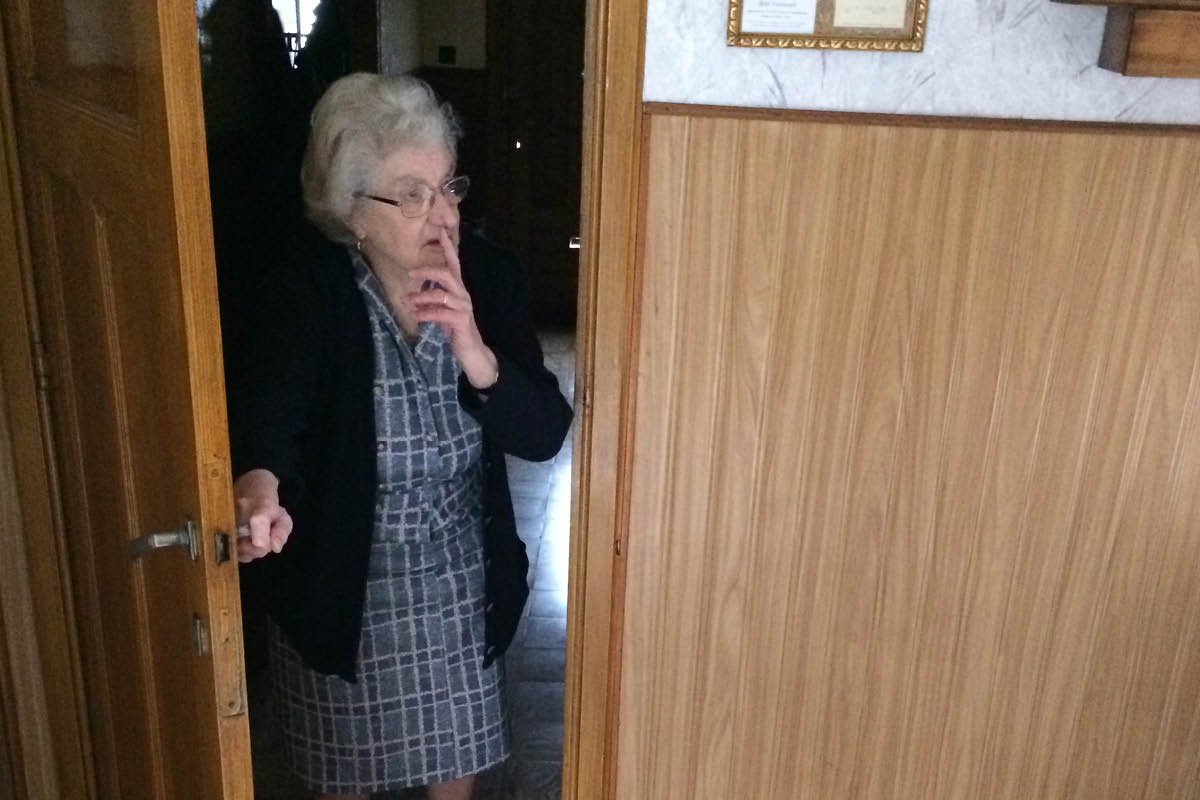
To the left and right at the back of the human skull lies a labyrinth, an octopus-like bridge between the ears and the cranial nerves. Here resides the vestibular system, a complex apparatus that gathers and disseminates cues of balance and motion. The body will go to any length to keep that skull level, its gaze aligned with the horizon: the flex of a knee, a slight tilt of the pelvis, a subtle torsion along the spine. I catch myself meticulously analyzing my own physical passage through Rein Dufait’s studio. The shift of weight from one leg to the other. The pivot of my head upon my shoulders and my eyes drifting over tables, cabinets, and walls as the artist guides me from one corner to the next.
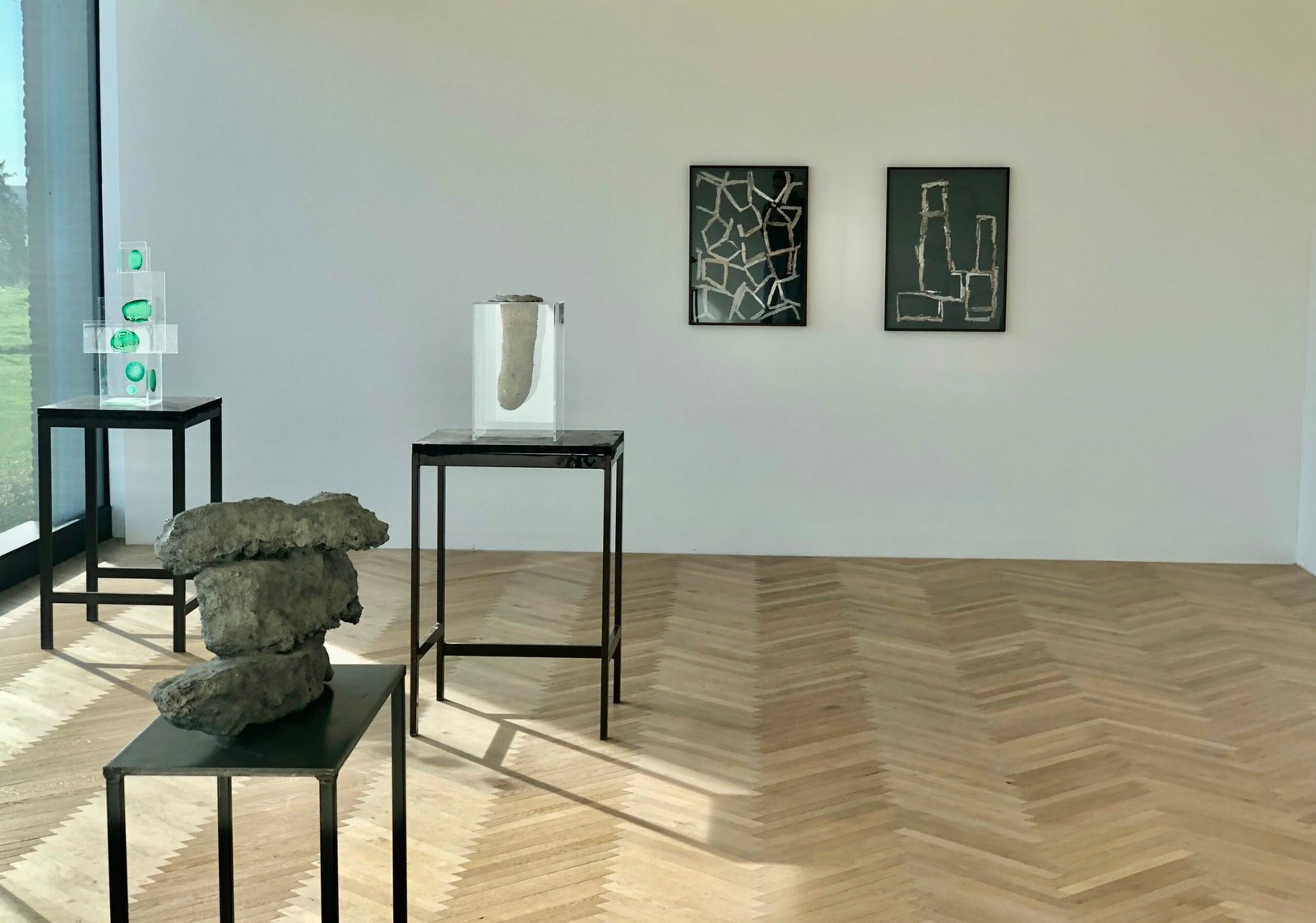
This is where things originate. Not simply one by one, but burgeoning steadily in clusters, troops, and swarms. They lie, stand, or suspend—a vital dance with gravity—inhabiting the space with deliberate intent. All around, I discern the echoes of serial iterations. Through a patient process of piling, assembling, adding, or stripping away, these objects sprout as tactile thought experiments. To reduce this artist’s practice to mere “sculpture” or “spatial installation” would fall short. For what unfolds here is all-encompassing and—above all—never finished.
Dufait’s oeuvre does not lend itself to easy deciphering: it chafes, it tilts. What remains clear is that it is fueled by a fundamental inquiry: the friction between mass and void. The artist creates from a deep-seated intuition, returning time and again to the foundational principles of sculpture. Concurrently, Dufait frequently trades the three-dimensional for the flat ground of paper and cardboard. “They have to be works you can keep looking at,” he tells me when asked if an artwork is ever truly complete. Dufait’s pieces teeter, reflecting the restless searching of the artist himself. There is no set modus operandi; it is an act of grasping and letting go. Always, the suggestion of a solidified gesture lingers.
As the creative process unfolds, stirred by serendipity, veiled references begin to surface. Often, one senses the whisper of a landscape—not solely through the use of natural matter, but within the contours and volumes: the grain of tree trunks, canopies, gently rolling hills. Closely bound to this are echoes of scaled-down architectural constructions, akin to architectural models. The sculptures hover somewhere between theatrical sets, forsaken ruins, and primitive shelters. Recurring structural motifs include the pillar, the freestanding partition, and the framework. The bodies of humans and beasts, alongside their traditional depictions throughout art history, pose equally relevant inquiries. The reclining nude and the torso—albeit abstracted to the extreme—surface here and there. Utilitarian and domestic remnants culled from the studio or daily life are likewise transmuted into sculpture or spatial components: colored pencils and wooden crates, a coffee cup, drinking glasses, plastic bags.
With titles such as Gevloerd (Floored), Dolalina, Gietpaal (Pouring Post), Doortocht (Passage), Stapeling (Stacking), and Takgestruik (Branch-Bush), Dufait reveals himself as a master of textual poetry. A nimble, subtly absurd humor—also felt in his sculptural interplay—bridges the gap to fresh possibilities. Alongside the sculptures, installations, and works on paper, the artist regularly produces artist books where he continues to indulge this delightful, ever-surprising experimentation.
Rein Dufait models, cuts or tears, binds, glues, but also fills, flattens, and welds. Unfailingly, he lets himself be guided by the latent possibilities of the material at hand. Though diverse, his building blocks are clearly defined, gathered by the artist from his immediate environment. We find ourselves barely two miles from the North Sea: its scent, taste, and presence reach right here, near the harbor in the hinterland. Shells, concrete, styrofoam, cardboard, plastic sheeting, branches, sand: both organic and synthetic, raw and recycled, utterly tactile elements fill his metaphorical toy box. Layer upon layer he assembles them, ever conscious of the poetry of impermanence.
He employs a primary palette of red, blue, and green acrylic paint much like raw masonry. These are stark hues that establish direct, signaling interactions, devoid of symbolic or emotional weight. Aesthetic intent and unvarnished functionality walk hand in hand. Dufait does not simply join one component to another; he transforms their juncture into a curiosity—crowning the newly formed triangle with sea shells, for instance. The same holds true for how the works are presented. Merely placing a sculpture on the floor or atop a generic plinth is seldom enough; the artist carves out a pedestal with his own hands and great care, crafting a base of wood or steel. Though strictly structural and not part of the artwork proper, it proves indispensable.
The moment of leaving the studio and situating the pieces in a fresh context invariably marks a transition for Dufait: a step forward, a leap sideways, a glance backward. Here, the light cuts sharper, the ceiling hangs lower, the colors vibrate in another key. The works ask only to be what they are. They coincide entirely with their form, their suggested motion, their substance and color. It feels as though they have always existed, drifting through a universe of Platonic ideals until one day conjured into being by the artist's hands. Only the attentive gaze will spot the sand clinging on—caught in the paint, on the plastic foil, embedded in concrete—and recognize that this oeuvre remains in perpetual flux. An eager anticipation of the coming tide.
Melanie Deboutte 2019